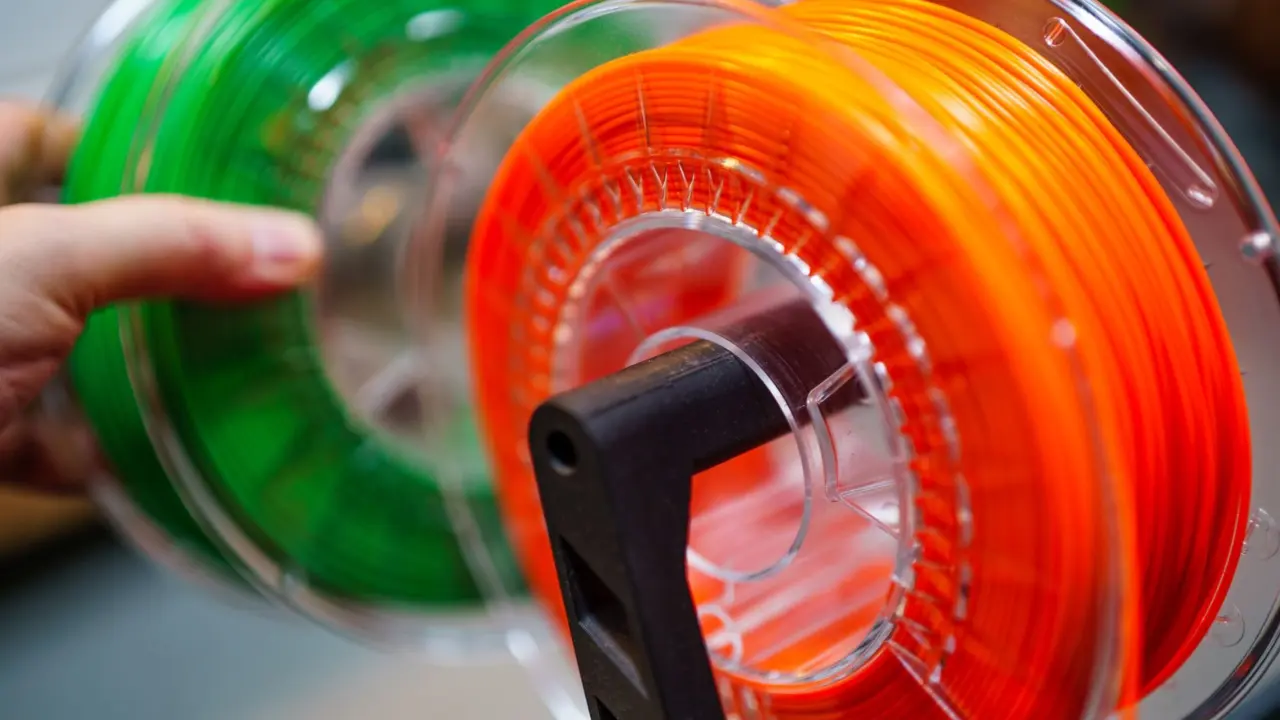
PLA filament is a plant-derived thermoplastic that prints at roughly 180–220 °C, softens near 60 °C, and is the easiest material for beginners to run on a desktop FDM printer.
It is the default material across 3d printing, and the sections below cover its properties, settings, uses and limits.
What PLA filament is and why it dominates
In 2022, PLA accounted for about 26% of total bioplastic demand worldwide, the highest consumption volume of any bioplastic, according to the Wikipedia summary of industry data. PLA stands for polylactic acid, a polymer made from fermented plant sugars, usually from corn starch. The same reference calls it the most widely used plastic filament in FDM printing, thanks to its low melting point, high strength, low thermal expansion and good layer adhesion.
Those traits translate into a forgiving workflow. The filament does not need an enclosure, rarely needs a heated bed, and gives off little warping stress compared with ABS. A printer that struggles with other plastics will usually still produce clean PLA parts, which is why it is the material most vendors ship as the sample spool.
The trade-off is heat. PLA is a thermoplastic with a low softening point, so a part left on a car dashboard in summer can sag. Knowing where that limit sits makes the rest of the settings easier to understand.
Key properties of PLA
PLA polymers have a glass transition of 60–65 °C and a melting temperature of 130–180 °C, according to the Wikipedia entry on polylactic acid. The glass transition is the practical ceiling: above it, a printed part gradually loses stiffness even though it has not melted. Wevolver, an engineering publication, gives a similar figure, saying PLA softens at about 60 °C and melts between 150 °C and 180 °C depending on formulation.
Grades differ because PLA ranges from amorphous to highly crystalline. Additives, colorants and the ratio of its two mirror-image forms all shift the numbers, so a datasheet for the exact spool is more reliable than a generic table.
- Stiff but brittle: PLA resists bending under light loads yet snaps rather than flexes when overloaded.
- Low shrinkage: thin walls and large flat bases stay flatter than in most other filaments.
- Low heat tolerance: the glass transition near 60 °C rules out hot-water, car-interior and microwave use. The Wikipedia entry notes PLA is unsuitable for microwavable containers for this reason.
- Moisture sensitivity: an open spool absorbs humidity over time, which shows up as stringing and rough surfaces, so a sealed box with desiccant helps.
Recommended PLA print settings
Most PLA filament brands recommend printing at 180–220 °C, according to Wevolver. Start in the middle of the range printed on the spool label, then adjust in small steps. Hotter settings flow better and bond layers more strongly, while cooler settings reduce stringing and sharpen small details.
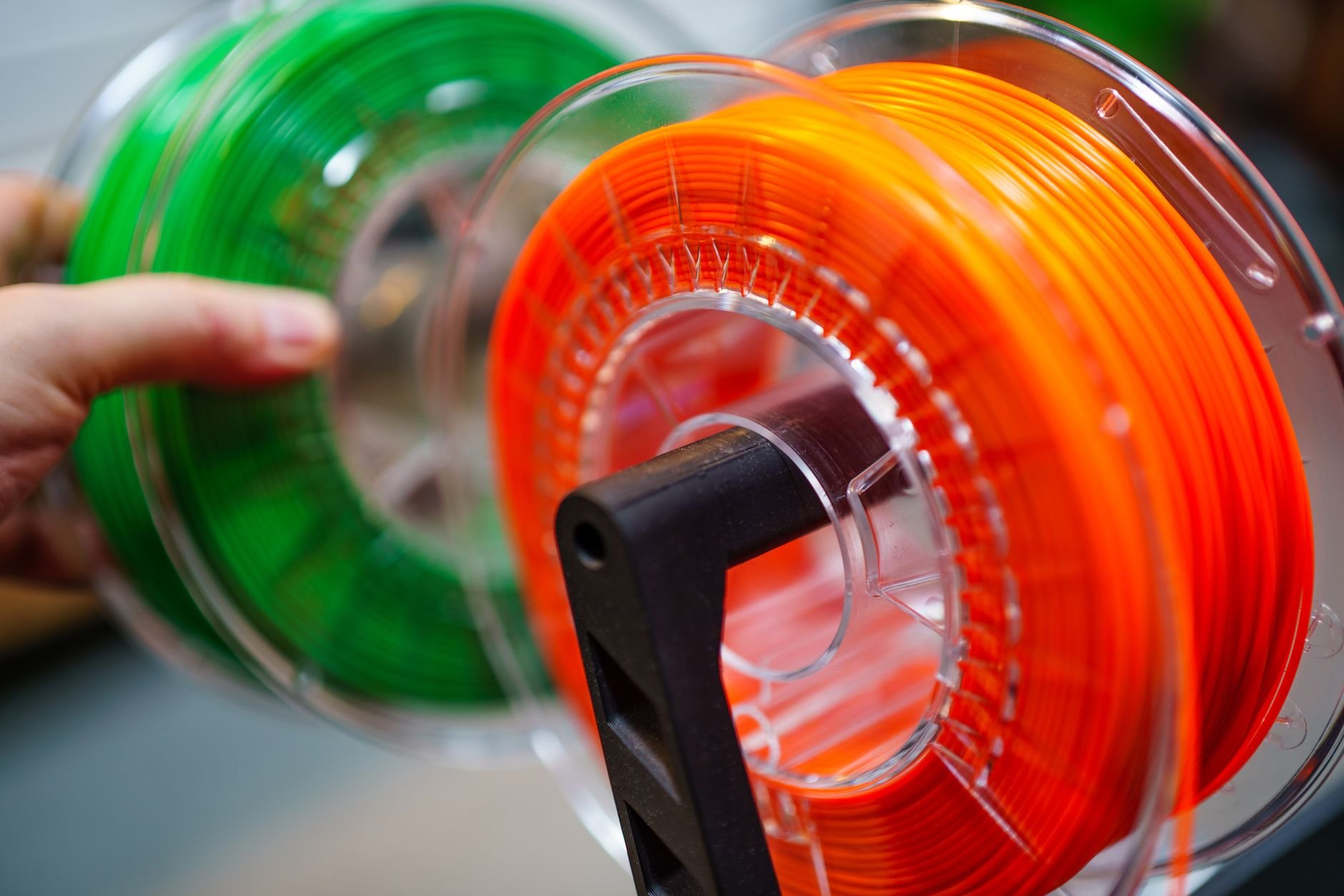
Bed temperature is more flexible. Wevolver notes PLA grips well at room temperature but can benefit from a bed between 40 °C and 60 °C. Staying at the lower end avoids heating the first layers to their softening point, which can cause a bulging “elephant’s foot” at the base of a part.
- Cooling: run the part-cooling fan hard after the first layers, since PLA solidifies quickly and bridges and overhangs improve.
- Speed: faster prints need a hotter nozzle to melt filament in time, so raise temperature before raising speed.
- Enclosures: leave the door open. A warm chamber near the glass transition can leave layers soft and cause slumping.
- Surface: a clean textured or smooth build plate, wiped with isopropyl alcohol, is enough for most prints.
Common faults map to a few causes. Stringing points to wet filament or an overly hot nozzle, and a nozzle that clogs mid-print often means heat is creeping up the hot end because of poor cooling.
Best uses for PLA
PLA suits any part that stays indoors, carries light loads and benefits from detail. Prototypes, display models, miniatures, desk organizers, cosplay props, jigs and educational models are all natural fits. The Wikipedia entry also lists compost bags, food packaging and loose-fill packaging among its industrial uses, showing the material’s range beyond hobby printing.
For household projects, the home 3d printing projects guide shows where PLA is a sensible choice, such as shelf brackets for light loads, cable clips and plant labels.
Avoid it for parts that live in heat, sunlight, or constant mechanical stress. Tool handles in a hot garage, dishwasher-exposed items and snap-fit clips that flex repeatedly are better served by a tougher plastic. The petg filament guide covers the usual alternative when PLA is too brittle or too heat-sensitive.
Heat-resistant PLA and annealing
Annealing heats a finished print so its structure crystallizes, raising heat resistance at the cost of some shape change. Wikipedia notes PLA has poor heat resistance unless annealed. Polymaker’s HT-PLA-GF, tested by 3D Printing Industry, shows the effect: the standard filament has a heat deflection temperature of 75 °C, and after annealing at 100 °C for 30 minutes it reaches 114.7 °C.
That test filament adds glass fibers specifically to keep parts from deforming during annealing, since most PLA parts warp when annealed. Its glass transition stays at 59.8 °C, so the improvement is in how much load the part carries when hot, not in when the polymer begins to soften. Glass-fiber filaments also wear brass nozzles, so a hardened nozzle is the usual recommendation.
For ordinary PLA, annealing is a trial-and-error process that can distort dimensions, so test it on a spare part before committing a fitted piece.
Environmental notes
PLA is made from renewable resources, yet it is not a quick-rotting plastic. The Wikipedia entry says complete degradation generally requires industrial composting, and that it can take close to three decades to achieve full biodegradation in natural settings. Its major degradation route is thermal decomposition at a minimum of 60 °C, which a cool garden never reaches. A failed print in a backyard compost pile will not vanish quickly.
The practical advice is to keep failed prints and supports out of general waste where a local industrial composter or filament-recycling program accepts them, and to print carefully to cut waste in the first place.
Frequently asked questions
What temperature should PLA filament be printed at?
What temperature should PLA filament be printed at?
Wevolver reports most brands recommend 180–220 °C for the nozzle. Begin with the midpoint on the spool label and adjust in small steps.
Does PLA need a heated bed?
Does PLA need a heated bed?
Not strictly. Wevolver says PLA adheres well at room temperature, though a bed between 40 °C and 60 °C can help first-layer grip.
Is PLA safe in hot places like a car?
Is PLA safe in hot places like a car?
No. Its glass transition is 60–65 °C according to Wikipedia, and a closed car in summer can exceed that, so parts may soften and bend.
Can PLA be made more heat resistant?
Can PLA be made more heat resistant?
Yes, through annealing or special grades. In 3D Printing Industry’s test of Polymaker HT-PLA-GF, annealing at 100 °C for 30 minutes raised heat deflection from 75 °C to 114.7 °C.